




By Capital Chanakya
This week, something rare happened on Dalal Street. The National Stock Exchange of India — the very platform investors use to buy and sell shares every day — finally floated its own ₹22,569-crore IPO, closing out a listing saga nearly a decade in the making. It’s the loudest signal yet of just how hot India’s primary market has become in 2026, and it tells us a lot about where things stand for anyone thinking of jumping in.
The NSE IPO, decoded
NSE’s mega initial public offering opened for subscription on September 17, priced at ₹1,700 to ₹1,785 per share, and closed on September 21. This makes it India’s second-largest public issue ever, behind only Hyundai Motor India’s ₹27,870-crore offer in 2024.
Here’s the catch for anyone hoping to cash in early: since the offering was entirely an offer-for-sale, all the proceeds went to existing shareholders — LIC, SBI, sovereign funds and others cashing out part of their stake — and not into NSE’s own coffers. Anchor investors including LIC, Goldman Sachs, Fidelity, GIC Singapore, Abu Dhabi Investment Authority and Norges Bank had already put in ₹6,746 crore a day before the IPO opened.
Demand built slowly and then surged. Day one saw modest interest, but institutional and non-institutional investors came in hard on day two, with the issue fully subscribed at 1.15 times, qualified institutional buyers subscribing 1.53 times their quota and non-institutional investors 1.65 times, while retail investors had booked 72% of their portion. Shares are set to list on the BSE— a moment years in the making, since NSE’s own listing plans had been stuck for nearly a decade over regulatory issues.
The bigger picture: a record-chasing year
Zoom out, and the NSE listing is just the loudest chapter in a much bigger story. Between January and August 2026, 62 mainboard IPOs collectively raised ₹73,673.54 crore, while another 126 SME IPOs raised ₹5,738.88 crore in the same period. That’s before counting NSE’s own issue and others still in the pipeline. Analysts now believe the full-year number could be extraordinary and the full-year fundraising could reach ₹2.4-2.5 lakh crore.
For context on how big that really is: India’s primary market raised ₹1,75,914 crore in 2025 and ₹1,59,783 crore in 2024 — both were record years in their own right. And going back further, India raised about ₹2 lakh crore through IPOs across the entire 2000-2010 decade, and a similar ₹2 lakh crore across 2010-2020 — but has already raised more than ₹6 lakh crore this decade alone, with 2026 expected to add over ₹2 lakh crore on its own. In other words, the pace of fundraising today dwarfs anything India has seen historically.
Does the IPO rush starve the secondary market?
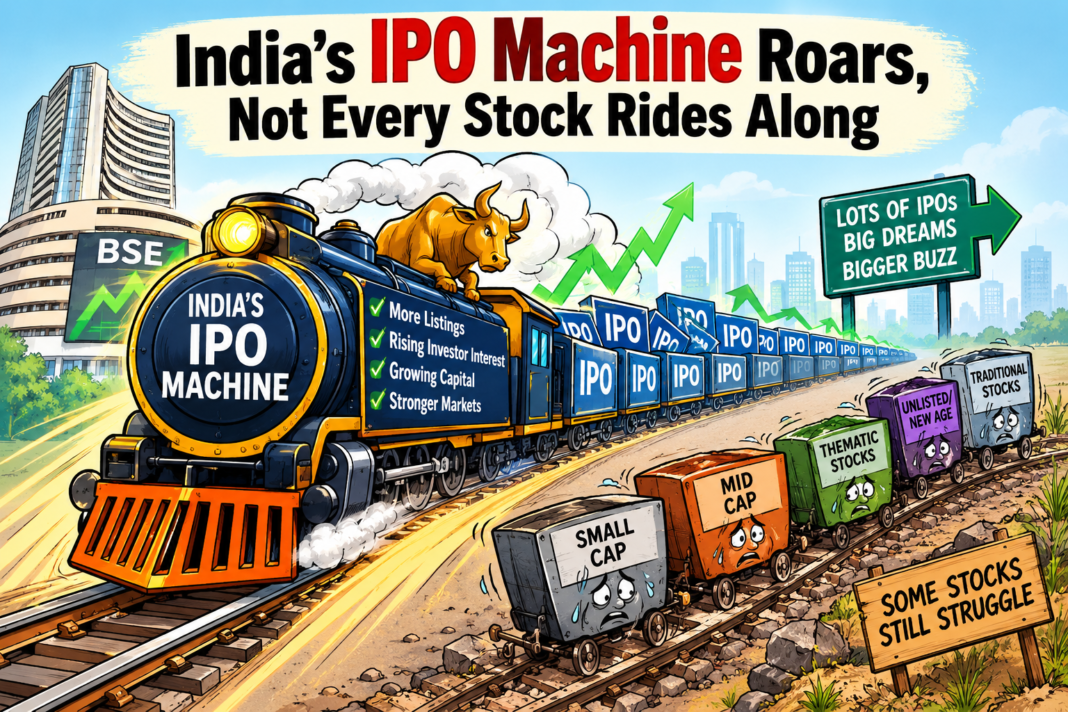
This is the question every investor should be asking, and the honest answer is: it’s complicated. India’s equity market is showing a striking divergence — while the broader stock market has delivered relatively limited returns over the past three years, the primary market keeps attracting companies and investors at a pace that’s hard to ignore, with IPO liquidity competing with secondary-market stocks amid continued foreign investor selling. Experts note this divergence exists because primary issues are fuelled by steady SIP and mutual fund inflows and rising retail participation, while the secondary market faces FII selling and valuation concerns.
So yes, there’s a real tug-of-war for investor cash — but it isn’t destroying the secondary market so much as redirecting where fresh money goes first.
Resilience — with caveats
Don’t mistake this for blanket euphoria, though. Earlier this year several closely watched candidates — including Manipal Health Enterprises, Indo-MIM and Juniper Green Energy — had to cut the size of their offerings to get deals done, while Zepto opted for a pre-IPO placement instead and PhonePe deferred its listing plans altogether.
The takeaway: the market is selective, not indiscriminate. Weak or overpriced issues get punished or postponed; strong ones get oversubscribed multiple times over.
Recent listings and what’s next
It hasn’t just been about NSE. Bharat Coking Coal debuted at nearly a 96% premium over its issue price, while Highway Infrastructure listed with a 64% premium, oversubscribed over 300 times. Hero Motors’ IPO closed subscribed 5.44 times on its final day. Looking ahead, Tata Capital’s IPO, Meesho, LG Electronics India, and OYO’s long-pending float are all queued up.
Investing an equal amount in every IPO in 2026 would have returned nearly 14% overall — and IPOs that listed in August alone returned 28%. That’s real money on the table, but it comes with a warning: not every issue delivers listing-day gains, sizes get cut when appetite is thin, and grey-market premiums (informal, unregulated indicators) can mislead as easily as they inform. The IPO window is wide open right now — but as always, it pays to read the fine print before you click “apply.”
instagram.com/save2gain